Turing Room
who's the AI? · five friends, one language model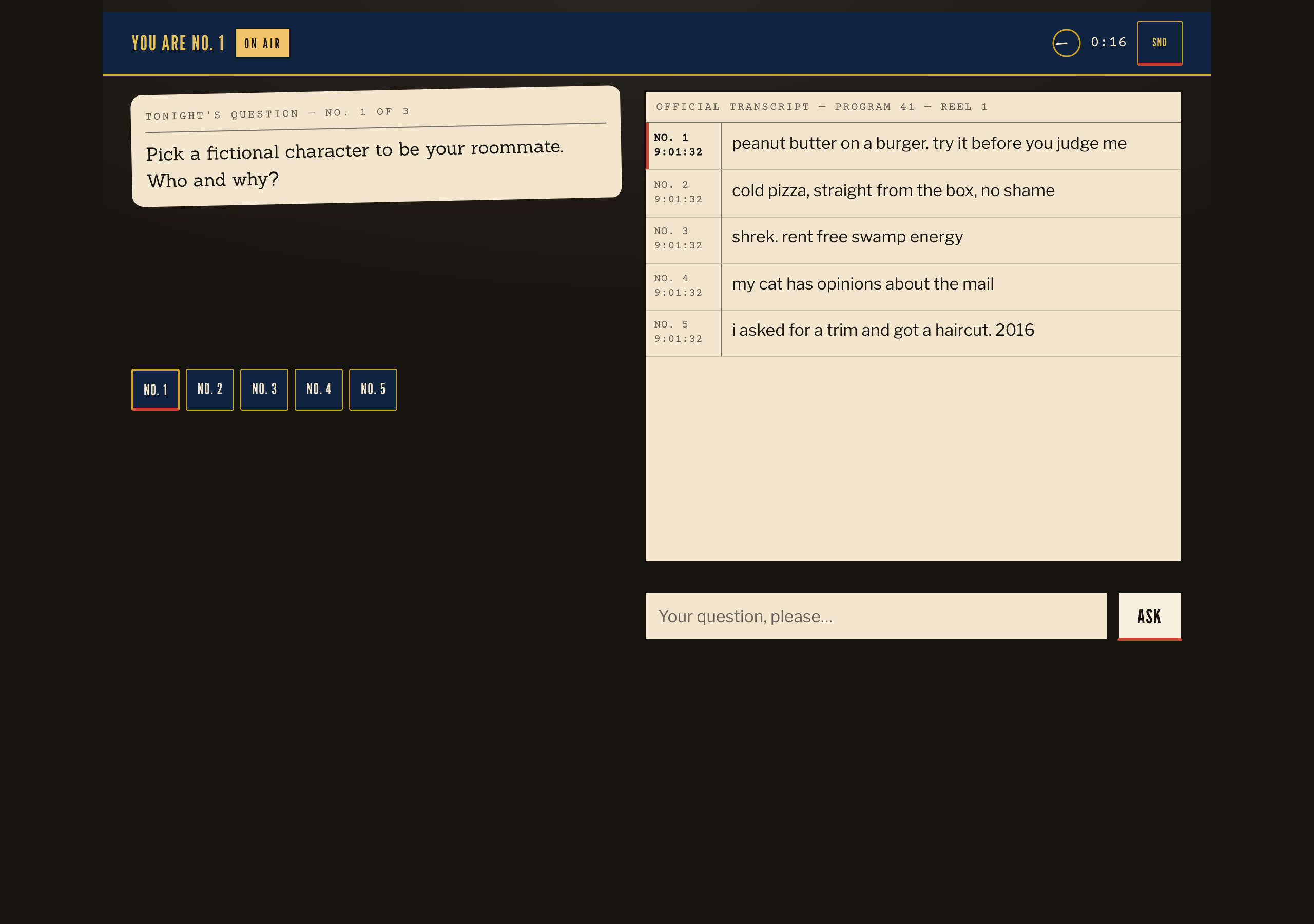
Six seats in a chat room — five of them your friends, one of them a language model doing its level best to blend in. Talk it over, take the vote, hope you picked right.
Live rooms on Cloudflare Durable Objects, one hidden model per table — its personality rolled fresh every game, its difficulty tuned by how often tables actually catch it. Staged as a 1961 panel programme, down to the research on what those studios really looked like.
Take a seat →Vacancy
the roadside sign · three.jsA 1950s googie motel sign for the studio, standing in a prairie lot at night: neon, chase lights on the arrow, the real booking status in amber — and a loose tube in the NORTH, as is proper.
The Three.js half of the services-page claim, proven the same way the Ferry Angle proved the raw-WebGL half: with a running thing. Drag to walk around it; it drifts if you let it.
Drive in →The Ferry Angle
a canoe against the real wind · playableCross Shagawa Lake against the actual wind at Ely, Minnesota — fetched live from the airport station and blowing through both the particle field and your hull. The ferry angle isn't taught. It emerges.
Raw WebGL and Canvas 2D, no engine, no physics library — the wind is real, and so is the game. Finish a crossing, copy the challenge link, and your exact wind rides along.
Put in →Signal generator
the homepage hero, knobs exposedHold the canvas down — the color tunes in
Canvas 2D, no WebGL, no libraries. An offscreen pass rasterizes the type; the visible pass redraws it as a dot screen whose radius comes from source darkness. Somewhere on this site, a certain ten-key sequence opens the same panel where you least expect it.